Friday, June 26, 2009

The Standard Model, Part 2: QCD

The other particle that many of us are familiar with from school is the proton. Protons have positive charge. Since electrons, as you will of course recall, have negative charge, they are attracted to protons. They want to bind together, and this is how atoms are formed. The electromagnetic force holds protons to electrons (the electromagnetic force is described by QED). But protons are fundamentally different than electrons. It turns out that, unlike electrons, they are composite particles. They are made up of smaller particles. These particles are called “quarks” after a line from James Joyce’s Finnegan’s Wake (“Three Quarks for Muster Mark”). Like protons, neutrons are also made of quarks. The term Hadron refers to particles that are made of quarks (there are more than just protons and neutrons, but those are by far the best known). So let’s talk about quarks.

There are 6 types of quarks that we have created and measured in a lab: the up quark, the down quark, the charm quark, the strange quark, the top quark, and the bottom quark. A proton is two up quarks and a down quark (sometimes written uud), and a neutron is an up dark and two down quarks (udd). The up quark has charge +2/3 and the down quark has charge -1/3, so we recover the well known properties that a proton has charge +1 and a neutron has charge 0.


Since quarks make up protons and neutrons (among many other particles), we know that there must be something that makes them want to stick together to form these composite particles. After all, we don't see free quarks flying around, we only see groups of quarks (quarks come in groups of two or three for group theoretical reasons). The things that bind quarks together, that make them stick to each other, are appropriately known as gluons. Gluons are analogous to photons. In QED, particles have positive and negative charge feel a force provided by photons. Therefore, one would guess that there was an analogous “charge” that quarks have which is related to gluons (just so we don’t get confused, quarks DO have ELECTRIC charge, and so they do interact with photons. But since they interact with gluons, they must have another type of charge).

It turns out that quarks and gluons are much more complicated than electrons and photons. In QED, there is only one “charge” (electric charge, of course). But with quarks and gluons, there are three types of charge. For lack of any better ideas, these three qualities that a quark can have were labeled “colors.” Most people call the three charges “red,” “green,” and “blue.” So, there are 6 types of quarks, but each quark can also be red, green, or blue. So, I can have a red up quark, or a green down quark, or a blue strange quark, or a red top quark, etc etc. And since it involves colors, the theory of quarks and gluons is called “Quantum Chromodynamics,” or QCD for short.


If you ask a physicist, they will tell you that QED is a very nice and clean theory. QCD is very, very messy. The main difference between QCD and QED is the difference between photons and gluons. Photons cause interactions between charged particles (like electrons). But they are not charged themselves. This means that photons don’t “talk” to one another. Photons only interact with charged particles, and since photons themselves aren’t charged, they don’t directly interact with photons. But gluons are different. Gluons interact with colored particles. But gluons themselves, it turns out, have color. Therefore, gluons are able to interact with other gluons. Two gluons can come together to form another gluons. One gluon can split apart into two gluons, or even three gluons. So, if you have one gluon, you have many. And if you have a quark, you have gluons. And if you have gluons, you have quarks. So, QCD is a mess. A quark flying along will emit gluons, which will make more gluons, which can make quarks, which make more gluons, etc. In the end, you end up with a bunch of particles that are all flying along. This big blob of particles that comes about from QCD is collectively called a “jet.”

So, to recap, QCD holds quarks together to form protons and neutrons. They can also become more exotic particles, like pions, kaons, and others that are named after Greek letters. QCD holds protons and neutrons together to form the nucleus of an atom. So, initially, QCD was called the “Strong Nuclear Force.” It is called strong because it indeed is strong. It is able to hold two protons together even though they should be repelled by the electric force (like charges repel each other). The study of nuclear physics is the study of QCD (usually just called the strong force in the context of nuclear physics). The reason that nuclear bombs are so powerful is that the strong force is so powerful. Nuclear explosions unleash the power of the strong force, of QCD. A gluon turns one quark into another, and releases a lot of energy in the process. QCD can indeed by quite messy.

Monday, June 8, 2009

The Standard Model, part 1: QED

The generally accepted picture of particle physics is known as the Standard Model. This collection of theories is the most successful physical model ever known and is able to make predictions that agree with experiment to unprecedented accuracies. For example, a quantity known as the anomalous magnetic moment of the electron can be calculated using Quantum Electrodynamics, which is one part of the Standard Model, and it matches with experimental measurements up to 14 decimal places. More or less, this means that one can zoom in by a factor of a trillion and the theoretical answer is still correct.

The standard model is an example of a Quantum Field Theory, meaning that it describes several "fields" and lists the ways that these fields can interact. Each field describes a different type of fundamental particle, so really the Standard Model is a list of the fundamental particles and the ways that they interact with each other. One doesn't need to really know anything about field theory in order to understand the particle content of the standard model, so let's dive into that.


Most of us are familiar with the concept of atoms and understand that they are made up of protons, neutrons, and electrons. However, if we zoom in closer, we learn that of these well known particles, only the electron is "fundamental," meaning that is isn't composed of smaller particles (as far as we know, of course). We should know a few things about the electron from high school. It has a property called "charge." The charge of the electron is -1, but that's just an arbitrary defintion of some units. The important point is that electrons are attracted to things with positive charge and repelled from things with negative charge (opposites attractive, likes repell, we see this among people as well as elementary particles). But what is charge really? Is there a more fundamental way to describe it beyond the ad hoc description above? Indeed there is. One a fundamental level, one can think of charge as the ability to interact with light. This seems odd, so let's qualify it a bit. Electrons interact with other charged particles via the exchange of light. Really, they interact with the smallest possible bunches of light known as "photons."

It turns out that all forces come about as the exchange of a particle. For every force, there is one or more particle that is exchanged. When an electron comes near another electron, they exchange a photon which carries the message that they should repell each other, and so they do. So, charge is the ability to communicate with photons, and therefore anything that is charged can talk to anything else that is charged by sending out or receiving a photon messenger.

The light that we see with our eyes is really just photon messengers talking to our rods and cones. There is an explosion in the sun. Two protons fuse together, and this process creates many photon messengers that go forth into the universe in all directions. Some of these messengers, after 8 minutes of traveling, hit the chemicals in our rods and cones and say, "There was a big explosion in the sun. Part of that explosion made red come this way in the form of me, the red photon." That's how we are able to know what happened 93 million miles away without feeling it with our hands. The photons told us!!

Let's go a bit deeper. In addition to electrons, there are electrons' evil cousins: the positron. The positron is just an electron but it has positive charge. It weights exactly the same. Since they have the opposite charge, they attract each other: they exchange a photon and tell each other to come closer. How romantic. The positron is known as anti-matter because it has the opposite charge as the electron, which is matter. Of course, the distinction is arbitrary: if we were made of positrons, we would call the electron the anti-matter. When electrons and positrons touch, they can destroy each other and release a lot of photons in the process. It's a cataclysmic event and they need to send out lots of messengers to tell the world. We can produce positrons in particle colliders, and we readily do, but they are quickly destroyed since the world is full of electrons to cancel them out.

The theory of electrons, positrons, and photons is known as Quantum Electrodynamics, or QED for short. It is a major component of the Standard Model. But really, it's quite simple. QED can be summarized by the fact that an electron and a positron interact via the exchange of a photon, two electrons interact via the exchange of the photon, or two positrons interact via the exchange of a photon. It's even simpler than that sentence if one understands Feynman diagrams (there's only one vertex between an electron, positron, and photon, and all possible interactions are built out of this one vertex like legos).


As you can see in the following diagram, each interaction vertex (where two lines meet) contains an electron and a positron (the two straight lines) and a photon (the wiggly line). Any such diagram that can be drawn that is made up of straight and wiggly lines where each wiggly line meets with two straight lines is a valid "Feynamn Diagram" in QED. If you aren't familiar with these sort of diagrams, don't worry, maybe I'll describe them in more detail in another blog.


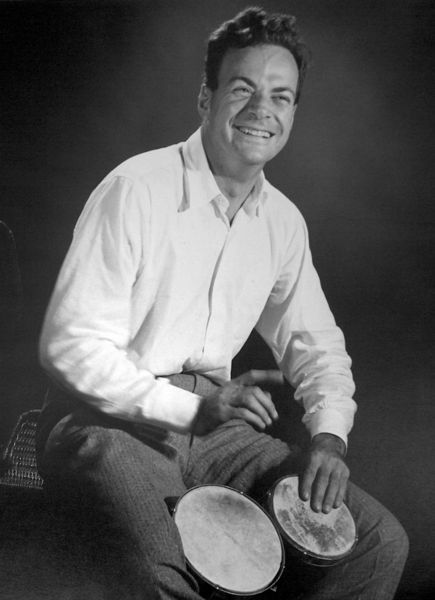
Richard Feynman, the man see above playing the bongos, was a central figure in the creation of QED in the 1970's.

The other parts of the standard model are Quantum Chromodynamics (QCD) and Weak physics (which will merge with QED to form ElectroWeak physics). So, stay tuned.

Monday, May 25, 2009

Symmetry

Oh, right, so why the title "Spontaneous Symmetry"? At that rate, what exactly do I mean by symmetry?

The concept of symmetry is one of the most important in physics. It can dramatically simplify problems, and often it is the only road toward an answer. The symmetries that are used in modern physics are often very abstract and esoteric, and are described by the beautiful field of mathematics known as group theory. The goal of group theory is to find general rules and patterns for systems that frequently appear in nature, math, physics, computer science, and nearly every field. Group theory describes things as ranging as a Rubik's cube, the energy levels of the hydrogen atom, cryptography, and countless other applications. But let's start off slowly.

We are all familiar with things that are "symmetric" in the layman sense. Something is symmetric if I can draw a line through it and it is the same on both sides. People are nearly symmetric if you draw a line through their head, torso, and between their legs, splitting their body in twain. For the sake of description, let's imagine a 2-d drawing of a human that indeed is perfectly symmetric. I can cut the drawing in half, flip one side over, and it will perfectly match the other side. A mathematician would describe this sort of mirror symmetry in the following way: I can take every part of the person, each arm, its hands, its fingers, its feet, etc, and I can reflect them to the opposite of the person and I will end up with the exact same image of the person.

One can imagine that if the person were holding a cane in his left hand and not in his right hand, he would no longer be symmetric. If I were to preform the above operation and switch the left and right sides, the cane would now be in the person's right hand. So, by swapping left and right, I DON'T get back the same image. The cane in this example breaks the symmetry.

Mathematically, this symmetry is described by taking things at position x and moving them to position -x (if we assume that the origin is aligned with the center of the person. In physics, this is called parity. The person that we imagined above (without the cane) is "symmetric under parity" or is "symmetric under mirror symmetry" or is "symmetric under reflections" or whatever term you want to use to describe it.

The point is that the symmetry that is most common to us is only a very simple example of symmetries. In general, a symmetry is defined as an operation that I can preform on an object that will leave the object the same. Consider a perfect circle. Certainly this circle also possesses the mirror symmetry that we described above. I can draw a line through the circle and flip each half over this line and the circle will be unchanged. But for the person, there was only one such line that I could draw. For the circle, there are infinitely many. The symmetries of the circle, we are starting to see, are much more rich and interesting than those of the person.

Aside from mirror symmetry, we are also free to rotate the circle. If I place my finger in the middle of the circle and spin the circle, it will appear unchanged (assuming the circle is indeed perfect). No matter how much I rotate it, I won't do anything. The circle, we say, is symmetric under rotations. Notice how this group of symmetries is different than the reflection symmetry from before. The act of reflecting is in a sense "discrete." You either do it or you don't. It's like being pregnant, you either are or you aren't. But rotations are "continuous." You can rotate by any amount, including none at all or any arbitrarily small or large amount.

Each of the sets of actions that we can do that leave an object the same form a "group." The set of rotations that we can do to a circle that leave it the same form what is known as the "rotation group" (specifically, for the mathematicians in the audience, it is called U(1), or equivalently SU(1) or O(2). This is also equivalent to the real numbers modulo the integers, and a fun exercise would be to find the isomorphism). The defining feature that makes these "symmetries" a "group" is the fact that any two symmetries done in succession make another symmetry. For example, if I rotate by 30 degrees and then by 80 degrees, it is the same as rotating by 110 degrees. It's as simple as that. I can also rotate backwards (ie rotating by -90 degrees is the same as rotating by a right angle in the opposite direction as 90 degrees), or I could just not rotate at all (identity).

Groups can be as simple as reflecting things and rotating squares and circles, but they can also be complicated. The more abstract ones involve matrices and complex numbers, but it's not necessary to bring them up in order to understand the main concepts.

So, how does any of this apply to physics? It turns out that for each continuous symmetry of a system, there is a corresponding "conserved" quantity. For those unfamiliar with this term, a conserved quantity is something that remains the same no matter what we do. For example, charge is conserved in the sense that you can't create charge, you can only move it. Energy is conserved, and you can only change its form, meaning heat is created when I use my laptop's battery. Momentum is conserved, meaning if I throw something in space in one direction, I will go flying in the opposite direction.

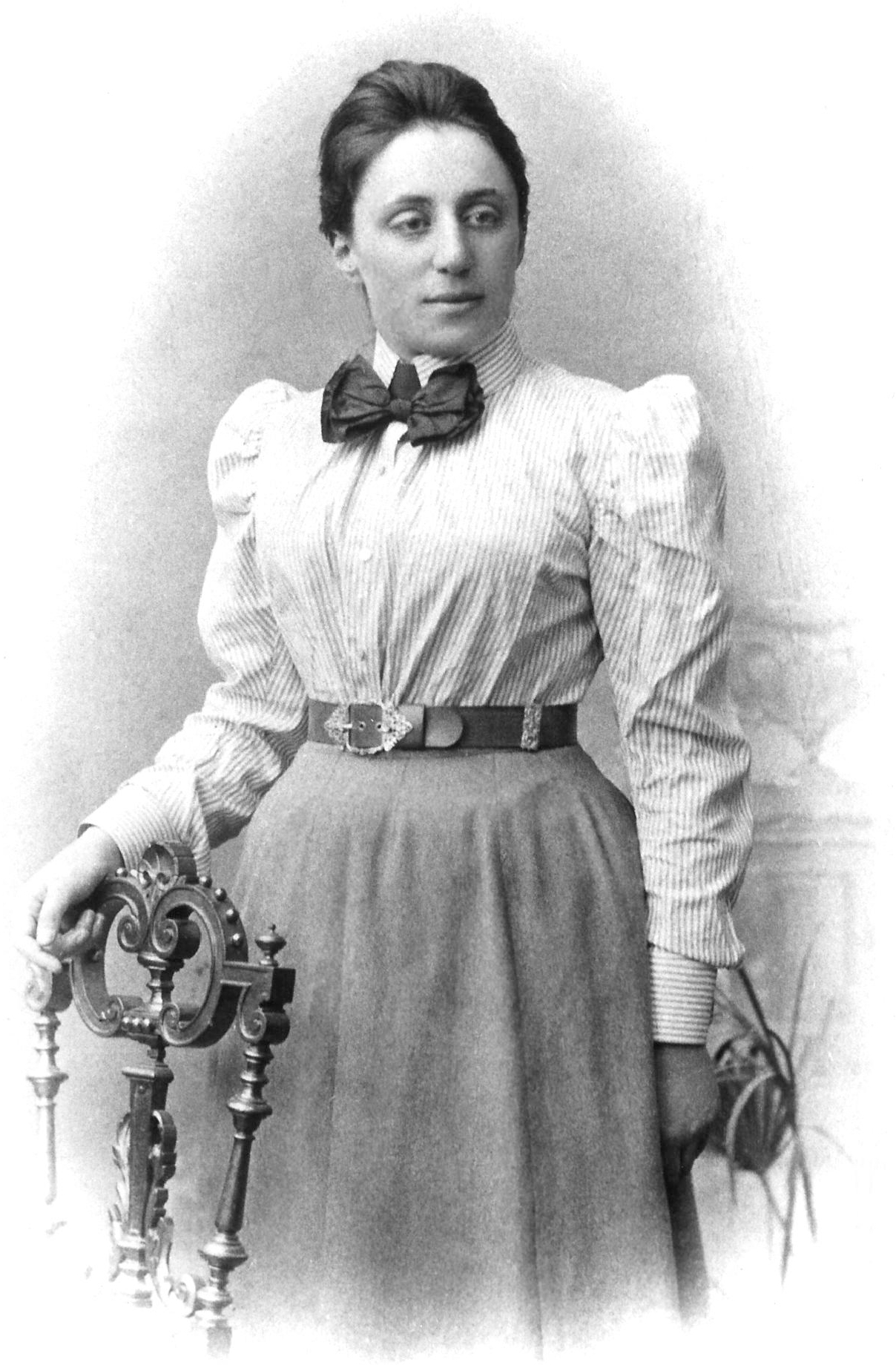
All of these conserved quantities can be derived from a symmetry of nature. The mechanism for doing this is one of the most beautiful theorems in all of physics. It's called Noether's theorem, which was first discovered by Emmy Noether (seen below). Einstein apparently called her the most important woman in the field of mathematics. It says what I just said, that each continuous symmetry leads to a conserved quantity (it just says it in fancy math language).


Conservation of energy comes from the fact that the laws of physics are constant in time (meaning if I preform an experiment at 3:00 in the morning, it should have the same results as if I did it at 5:00 in the afternoon, ignoring external differences associated with the different times of day such as daylight, weather, etc). Conservation of momentum comes from the fact that the laws of physics don't care where they take place (meaning they are the same here as well as in the Andromeda galaxy, or they are "symmetric under translations").

Conservation of charge comes from the fact that a rotation of electron fields, similar to the circle rotation above, leaves the energy of the system unchanged. This is of course mostly nonsense to those who aren't familiar with Quantum Field Theory, but I assure you that it's no more difficult than spinning a circle about its center.

Tuesday, May 19, 2009

Two Envelopes: Answer

I'll start off by addressing the comments.

Just to reiterate, the paradox is the idea that for all possible values that we find in the envelope, switching is advantageous. To Erik, this clearly makes no sense because there is nothing that distinguishes the envelopes. This is different from a situation where we have a particular value, say $100, and are given the option of switching for either $200 or $50 with equal probability. Clearly in that case switching is advantageous.

To Mr. Zrake's argument, you have shown that having a strategy of always switching will not be advantageous. This is different than the idea that once we've opened the envelope and seen a particular value, we always want to switch. Let me explain with an example. Imagine that I tell you in advance that the envelopes contain exactly $50 and $100 and you get one envelope with a 50/50 chance. Clearly, in this case, a strategy of always switching is clearly going to have the same expectation value as a strategy of always staying, which is just the mean of the two envelopes. However, if you open the envelope and see $50, you should always switch and if you see $100 you should always stay.

The last example I think is a big hint toward the end of the paradox. See, if we know in advance how the envelopes are filled, then our strategy should be clear. Let's go back to the beginning. We haven't discussed how the person decides how much money to put in every envelope. The only constraint thus far is that one envelope should have twice the money that the other has. When we open a particular envelope, we know that the other has either twice the money or half the money. The key, however, is that there isn't a 50/50 chance of it either being half or double as one would naively expect. The relative probability between half and double depends on how the envelopes are filled, ie it depends on the probability distribution that the filler uses to pick what amount of moeny goes into the envelopes.

And here's the real key: It is impossible to have a probability distribution where, for every x that we see in the envelope, there is a 50% of the other having half and a 50% of it having double.

To be more concrete, let's say that the filler chooses to fill the envelope in the following way: he has some probability distribution p(x) that he uses to randomly fill one envelope. He then fills the other envelope with double that amount, and flips a coin which determines whether he gives us the larger or the smaller envelope.

So, if we open our envelope and see X dollars, it means that one of two things happened. Either the "seeded" number was X and we got the smaller envelope, or the seeded number was X/2 and we got the higher number. The expectation value of switching when we see X in our envelope is:

EV(switching) = N * { p(X)*2X + p(X/2) * X/2}, where N is a normalization constant such that the probability adds up to 1.

Clearly, this expecation value depends intimately on the probability distribution function p(X). If we were to know explicitely this function going in, then we could determine the proper strategy by comparing the above expectation value to X. If we DON'T know this function going in, which is the case presented in the original problem, then we CAN'T come up with the optimal strategy. However, that doesn't mean that ALWAYS IS correct to switch, it just means that we can't determine the correct answer because we don't have enough information.

Friday, May 15, 2009

Two Envelopes Paradox Question

A man comes up to you on the street that you've never met. He generously offers to play a game with you. He says that he's going to take two envelopes and fill them with money. One of the envelopes is going to contain twice as much money as the other, but he doesn't tell you what either amount will be. He will then give you one of the two envelopes randomly with a 50/50 probability of getting either. He will let you look in it, and decide if you want to keep that money or if you want to switch envelopes and be forced to keep the amount in the envelope.

Let's say that you open the envelop and see $100. Should you stay and be happy with your envelope, or should you switch and potentially get $200 or end up with $50.

Well, half the time you have the higher envelope and half the time you have the lower envelope, so your expected value for switching is:

E = (1/2) * $200 + (1/2) * $50 = $125

Your expected value for switching is more than the $100 that you would always get by staying. So, based on the math, you should switch envelopes. Easy problem, right?

But, if you think about it, the situation makes absolutely no sense. Nothing was special about $100. For any amount X, the expected value of switching is 1.25*X, so we should conclude that we should always switch when we are given the envelope. Thus, we can mathematically switch envelopes even before we look. The paradox lies in the fact that there is a natural symmetry between the envelopes. Since we no nothing special about either one, how could it possibly be preferable to switch? They are both equally likely to be the bigger one, so we should really break even by switching. It should gain us no advantage. But the math is simple and clear. So, what's going on here.


This is known as the two-envelope paradox. It's pretty interesting, I think, and it really stumped me for a while when I was first thinking about it. The solution is somewhat non-trivial but is also enlightening. So, I encourage you to think about the problem and to see if you can figure out what's wrong here. I'll post my take on the solution later.


Incidentally, Wolfram Alpha is now online, and I'm playing with it a bit.

Monday, May 11, 2009

Wolfram Alpha

This has been getting a lot of hype recently. It remains unclear whether Stephen Wolfram's ambitious new project will live up to expectations and change the way we use the Internet or whether it will be yet another overblown flop that we check out once before returning to Google.

Wolfram is a very ambitious man. He is a renaissance man, and his work spans the the fields of mathematics, particle physics, cosmology, and most notably computer science, symbolic algebra, and cellular autonomy. Wolfram is best known for his development of a fantastic computer program known as Mathematica. In a nutshell, Mathematica is the world's greatest calculator. Really, it's a computer language used to preform symbolic manipulation (in other worlds, it does math on abstract objects and functions whose exact definitions may or may not be defined).

The idea that ties all of Wolfram's projects together is chaos theory. Wolfram is extremely fascinated by the concept of very complicated systems emerging from simple rules. [Really, all of nature is a complex system that emerges from a relatively small amount of rules. Of course, we don't yet know what these rules are. We know what they look like in certain energy regimes, but we don't know how many there are (there could be only one, or there could be infinitely many). It is the goal of physics to find these rules.]

Consider an anthill. Any particular ant is extremely stupid. They have a very primitive brain whose main job is to interpret sensory information, mostly in the form of smells, and convert this into one of several simple actions. If an ant smells a certain scent, it follows it. If the ant smells an egg with a certain pheromone, it moves the egg. If an ant smells another ant, it attacks that ant. One could write out a list of a dozen or so rules and one would fully define the ant, more or less. However, as a whole, the anthill is a very complex beast. These few, simple rules, when scaled over hundreds of ants, become a giant living brain capable of surviving, finding food, growing, digging, moving, and attacking. The anthill really is one giant brain and each ant acts as a neuron.

Birds fly in beautiful patterns in the sky. They flock as huge groups and always know where to fly as to not run into other birds. But really, all any individual bird knows is the following: if you see a bird of your type flying, fly behind it but slightly to the side. Flocks are the emergent behavior of this simple rule.

Okay, so back to Wolfram. From rules come complexity, from order comes randomness. This is exemplified by something invented by Stephen known as “Rule 30.”


Rule 30

Rule 30 is a simple rule for moving through a series of bits and changing each bit one by one based on the value of the bit and its nearest neighbors. In other words, one starts with a long string of 0's and 1's. One then goes to each 0 or 1 and changes it based on the following rules:

111 -> 0
110 -> 0
101 -> 0
100 -> 1
011 -> 1
010 -> 1
001 -> 1
000 -> 0

There are 8 rules and they represent all possible combinations of three binary numbers.
In other words, if we come across a “1 1 1 x”, we change the middle number to 0 so it becomes “1 0 1 x” and then we move on to the next bit, which would be “0 1 x” and apply the rule again. We do this for as long as we like, and from these simple rules chaotic patterns emerge. Just as ants, birds, the very neurons in our brain, quarks, gluons, electrons, photons, and all other elementary particles run on some set of rules and yet create complexity.


Dr. Ian Malcom and Stephen Wolfram would certainly be good friends.

Wolfram Apha is designed as the next step in human-computer interaction (it takes us a very large step toward Skynet.). It is the computer system envisioned by countless sci-fi authors decades ago. You ask it a question and it gives you an answer; simple as that. (Good examples of stories based on this idea are “The Last Question” by Issac Asimov and EPICAC by Kurt Vonnegut).

The Last Question

EPICAC


It's supposed to come online this week, and I look forward to playing with it. And I'd say that there's only a 10% chance that when turned on, it will begin the war with the machines. And even if it does, we could always ask it to play tic-tac-toe against itself. That's every sentient computer's kryptonite.

Sunday, May 10, 2009

Boy or Girl

So, who doesn't love getting confused by probability? I know I do. Let's just jump in right now without further ado.


A couple has two children. Assume that when a person gives birth, they have a 50% chance of having a boy and a 50% chance of having a girl. The couple tells you that at least one of their children is a boy. What is the probability that the other child is a boy?

This is a pretty simple puzzle in terms of calculations, but it causes a lot of confusion in a lot of people, so I thought it'd be fun to address. Since the chances of having a boy or a girl is 50/50, one would naively assume that the knowledge about the first child doesn't effect the probability of the other being a boy or girl. Thus, most people say the answer is 50/50.

But this is of course wrong. If the couple tells you that they have at least one boy, there is a 2/3 chance that the other child is a girl. Weird, right? Remember, this has nothing to do with correlations between children. We are assuming that all births are independent of each other. So, why is this so. The easiest way to figure it out is by examining the ways that a couple can have two children and finding their probabilities. They are as follows (B = Boy, G = Girl):

BB 25%
BG 25%
GB 25%
GG 25%

Each of these have an equal probability (50% * 50% = 25%). If the couple tells us that they have at least one boy, than all that they have done is eliminated the last way of having two kids; meaning that we ignore the GG combination.

Thus, the remaining combinations are:

BB
BG
GB

and they occur with equal probability. Of the remaining choices, two of them involve a boy and a girl, and the other involves two boys. Thus, it is twice as likely to have a boy and a girl than two boys. Thus, if a couple tells you that they have at least one boy, it means that 2/3's of the time, their other child is a girl. This is really a problem of semantics. Most of people's confusion comes from the idea of having "at least" one boy.

We get a different answer if we phrase the question in the following way: "A couple has two children. The youngest child is a boy. What is the probability of the sex of the other child?" Here, the answer is 50% boy and 50% girl. So, what's the difference? Again, it becomes clear if we list the possibilities:

BB
BG
GB
GG

If they tell us that the younger child is a boy, we are only left with:

BB
BG

and these have equal probability. Thus, the second child is a boy half the time and a girl the other half.


Interesting, no? This is a relatively simple problem. Maybe we'll get some harder ones in the future...